Law on Compulsory Education

By Aventurijn on April 1, 2007
Category: Regulations
Responses: none

OPEN LETTER
Loenen, Wednesday 26 March 2007

Members of the Houses of Parliament,

Tuesday the 23rd of March, the House of Commons debated concerning the bill to adaptation of the Law on Compulsory Education (LCE). Goal is: bringing the public schools and the private (read: pioneering) schools in one line control. The process leading to this bill is controversial. Several Councils and other Governmental Institutions have advised negatively or are not even heard at all.

The Governments Educational Inspection reported already in August 2006, that true innovation has become impossible since the “Law on Educational Inspection 2002″. At the time only valid for higher education, due to the new LCE, innovation has become impossible on ALL levels.

The State-Council was very clear in its criticism on the amending proposal: The planned amendment puts an end to freedom of education! The Council made further observations concerning the need of the proposal, the constitutional implications and the transition aspects. The recommendations were negative in every aspect. The Council even criticises the complete necessity of the amendment where it states: “it is recognised that the legal basis on which the Government can enforce quality requirements is already present.” Putting additional law into action is therefore superfluous.

The Education Council, the Government’s main Education advisory council, has not even been heard at all!! This council stated in 2002, in negative advise to the forming of the Law of Educational Inspection, that this law should not be the instrument for Educational quality-improvement. Of course, it is likely that this Council is opposed to this youngest amendment too.

This proposal to Law on Compulsory Education is said to be developed “in consultation” with the educational field. That is only seen from one point of view. ” the education field ” feels itself manipulated.

The core of the matter is this: The well-known methods and fixed programmes are not appropriate for all pupils. The enormous numbers of truants, the large numbers of school-leavers and the aggression in schools show this clearly. There needs to be space
for pioneering schools. There needs to be space for children to learn on the basis of their own brio, their own tempo and in their own manner. Fear for “Muslim schools”, indicated by the chief inspector of the education earlier as the main reason lying behind this amendment to the law, may not put an end to freedom of education.

Mentioned below is an enumeration of the most fundamental lacks where the bill leads to i.e. what is does not change:

LEGALLY:

  • No possibility has been created for a counter-evaluation on an inspection report. That is absolutely necessary. The Inspection hardly understands the pioneers.
  • There is no institute accredited to deliver “equivalence declarations” (these are well known in the world of Dutch construction)
  • The authority of a school is responsible for the quality of their education, but has no legal status in procedures and therefore cannot go for higher appeal against a judgement of the inspection. Parents, in cases of a negative inspection-report on the school, face criminal charges. These criminal charges may be handled by the public prosecutor without involvement of a judge.
  • Private schools on which a negative inspection report is published can be closed directly, without getting further time to make improvements. This condition does not apply to public schools. That is improper justice.

POLICY:

  • By means of the enforcement of the current criteria for subsidized schools to the private schools, an obligatory, extensively detailed, but undesirable “break” between basic - and higher education. Several private schools support an uninterrupted development (just like the legislature!).
  • Individual profiles become impossible in this law. The private schools and students are forced to follow the profiles and the detailed schemes of the so-called “Mammoth-law”. (Yes, mammoths are extinct) The majority of private schools have deep-rooted reasons to consider such profiles as one of the main problems in public education and therefore reject these.

CONCLUSIONS:

This adaptation of the Law on Compulsory Education is:

  1. Superfluous, because badly performing schools already can be tackled;
  2. Stalemate, because it terminates the own responsibility of parents;
  3. Untimely, because new education need a larger time-frame to prove itself

And dangerous, because:

  1. elementary judicial foundations are violated;
  2. because the freedom of education “de facto” disappears
  3. because the minister can curtail further freedom of education without consulting Government
  4. because necessary innovation will be no longer possible;
  5. because more and more mistrust is institutionalised and that the government and the citizen become divided.

Michaƫl de Vos,
Aventurijn

A selection of responses from all over the world:

“Each of you who places a vote is a separate individual, each with the power to say no. Please think very carefully before you become responsible for yet another step in the devastating mono-culturing of our world.”

Juli Gassner
Assistant Principal

Gardeners Rd Primary School
Sydney, Australia

“Currently there are private schools in your country that serve as models for the democratic style of education, a style that is expanding around the world right now, satisfying many families and communities. This valuable learning approach will be destroyed if this new law is enacted, surely not what is intended? If so, I would be deeply disappointed and surprised that a country known for progressive and experimental ideas would have produced such a negative outcome for education–it would be chilling indeed.”

Sally Rosloff
California, United States

“Why must those in power reduce the personal powers and opinions of others? This imperial attitude is patronising and can only come from hidden fears. There is enough of that already in the world, so why add depersonalisation to classrooms the like of which is found in barrack rooms.”

Christopher Gilmore

“Together with Denmark, the Netherlands are viewed as
enlightened and progressive in regard to educational policy and practice in
other parts of Western Europe such as the UK and Ireland. It is vitally
important therefore that govermental support and tolerance of democratic
schools in Europe is continued, strenghthened and extended throughout.”

Alison Cordingley
County Cork
Ireland

“Having different schools and different options for the education of your children will strengthen
your country not weaken it.”

Moe Zimmerberg
The Tutorial School
Santa Fe, NM, USA

“Two years ago I attended some public schools in the Netherlands as well as the Aventurijn Free School in Loenen. I was simply astounded by the zest for life, general enthusiasm for learning and above all the amount of knowledge that the children of Aventurijn demonstrated. During my many years of teaching I had never witnessed the likes of that in any school in South Africa.”

Douwe van der Zee
Teacher, facilitator and author of ‘Wisdom of the Most Conventional Kind?

“It would be a pity if a free country like the Netherlands offers less freedom to her children than a small, poor country in Afrika…”

Best wishes,
Gerard Mathot,
Seliba Sa Boithuto

“Democratic education is now offered to over 40,000 children around the world
in over two hundred places, in more than 30 countries, and the movement is
growing all the time. Holland is seen as a leader in this development.
…… If the government in the Netherlands can throw itself behind such innovation, it
will retain its image as an example for the future.”

David Gribble, U.K

“For the last few years I have been reading in Ode –a Dutch magazine of contemporary culture– all kinds of accounts of the radical and visionary schools in Holland, schools that have been an inspiration to educators all over the world. I wonder if Holland now really wants to go backwards, maybe even further back that America has gone.”

Todd Pratum, Pratum School & Library.

Options:email post email postleave a responsetrackback

What’s Next? Consciousness!

By Aventurijn on July 12, 2006
Category: Education
Responses: none

Last week an enormous tipi was built on the premisses of our democratic school Aventurijn in the Netherlands. All children and tutors could sit in the tipi around the fire and listen to stories, sing native Indian songs or make bread on the fire. Together we created an atmosphere of peaceful togetherness. It was a deep learning experience without calling it learning:

  • learning from life;
  • learning from examples (both of behaviour and knowledge);
  • learning from the being of adults and other children;
  • learning with heart, body and head.

Of course the children didn’t have to be in the tipi because their freedom to choose what they want to do, is an important condition at the school. A condition; not the ultimate goal. There are more conditions like providing safety, love, a rich environment etc. A condition means that there is more than just freedom and democracy. A lot more. For us, the only real goal of our school is the unfolding of the inner self in the human being: both with children and adults.

A BBC research resembled our own experiences, that in any communicative situation, 55% of what’s retained is the context. Body language, facial expressions and attitude constitute 38% of what will be remembered. With regards to the content of what has been said, this will only make up 7% of what is recalled later in time.

The knowledge gained by this research implies some major consequences for our current (formal) education. If you leave a child in an enclosed room with no other people or interesting things around to engage with, there would hardly be any development. It is important to create an environment which contains a lot of meaningful and interesting things and also inspiring people which surpass the notion of ‘just happening to be there’.

Last winter one of the tutors worked on a project about the Celtic culture. There where a lot of Celtic activities which the children could join in if they wanted. A lot of them didn’t, but the information was all around. To be heard, to be seen, to be felt, to be tasted, but more: ‘it was in the air’. A few weeks later one of the boys whom I thought had done nothing with this subject, was suddenly telling me a lot about it. While playing he had picked up on much of the Celtic information. On Aventurijn we call this ‘learning from thin air’.

It naturally follows that everything which happens at school has an influence on the children. When you are aware of this mechanism as a facilitator, you hence have the responsibility to keep a close eye on the whole atmosphere around each child. Because even if a child does not ask for this information, it will come in subliminnally. You therefore have to ask yourself continuously: what do I want to give these children.

Which leads me to the most important issue in my opinion: the awareness level of the adults.

You can give the children as much freedom and democracy as you want. But only when the adults are conscious about their own processes and work on their personal development, the children will have useful examples and references to grow up to. The behaviour and whole-being of the people around the child are of the highest importance when it comes to the child’s own development.

How does all of the above translate to the lessons the children ask for, like mathematics, physics, languages etc.?

We could offer a book or an ordinary lesson just like teachers do in thousands of schools around the world. Some children will even like it, but the question is: would this the most effective way of learning?

I don’t think so. There are a few thing that need to be mentioned in relationship to learning:

  • Every human being has his or her own preferred way of learning (with reference to the multiple intelligences theory by Howard Gardner). Some learn best when being outside, others want to move, some learn most by doing games or playing music, etc. etc.

  • Your learning is most effective when your heart and brain are working together in harmony.

  • A child needs to feel that it is totally accepted: mistakes don’t exist, neither do tests nor anything else which could imply that you are good or bad.

  • The teacher really has to believe that the child possesse an innate knowing about everything. All knowledge is already somewhere within, you only have to remember where.

  • When a teacher engages in real deep contact with the being of the child, a direct exchange of information can happen (with reference to the book: ‘Anastasia’ part 3, by V. Megre).

It’s my experience that social and emotional learning are as important as cognitive learning. Only when a child experiences total safety in its being, there is room for cognitive learning.

For this reason we pay a lot of attention to this. It also is the reason that the adults are the first ones to set examples by their way of being. The way in which we communicate with each other and the children is very important. Things that we pay attention to are:

  • What is your body-language telling?
  • What are you really saying behind your words?
  • How do you manage your own emotions?
  • Do you dare to share them with the children?

Then of course there is the developmental process of the child itself. We help a child to express and manage its emotions as required by the situation or when the child asks for it. But also in the group we offer activities, stories and games that give the children the opportunity to develop their social and emotional being.

Emotionally ’safe’ games for instance would be co-operative ones instead of competitive. We play them a lot. No winning, no losing. The effect of this is enormous! Children just play for fun, even when they themselves play a competitive game. I hardly ever see sad children because of losing, since we started doing co-operative games.

When a new child starts at our school and its behaviour is more violent than we are used to, I often hear children saying: “Oh well, he is not used to the way we interact yet; it will come.”

After being freed from compulsory education, the time has come take the next step. Adults have to unfold their own inner-self and doing so, consciously create the conditions for the children’s development.

We could write books about how we do that in our school, Aventurijn, and yet we are still in the middle of these developments. A lot of other people wrote books already about some aspects. Important books that might be interesting for you, to find out ‘what is next’ for you and your school.

I wish you a very inspiring conference!

Always open for questions and remarks,

Hannah de Vos-Beckers
Founder of Aventurijn

(This article was written for the international conference of democratic education 2006 in Sidney, Australia)

Options:email post email postleave a responsetrackback

Agression or Harmony? It’s up to you really…

By Aventurijn on May 5, 2006
Category: Education
Responses: none

Aggression is one of the most terrible developments nowadays. Especially in schools you see the violence of the youth increasing. Is it television, computer games, or society as a whole which makes children so aggressive? Or could it perhasp have anything to do with the school system itself?

  • How can you ask children to be non-violent if their teacher constantly shouts?
  • How can you expect the children to listen, if the teachers don’t listen to the children.
  • What do the children really want?
  • Are they enjoying their life of sitting in a classroom and learning abstract stuff because the teacher said so? Are these children happy?
  • And will they be happy after leaving the school?

Aventurijn is a small private school in the Netherlands where children can learn in freedom from life itself: life is the teacher and the world is the classroom. There is no curriculum, and there are no teachers. The adults at school are just people with a little more experience in living. We call them ‘guides’ or ‘facilitators’; someone who helps you to discover your own way of learning and living.

Our adults help you by listening, conducting lessons, making proposals or just by being an example. This way children love learning and living; they actually ask for homework and classes, but they also play a lot and have much fun.

Don’t we have aggression at all?

Of course we have!

There will always be some violence because aggression is a part of life, but we believe that aggression can change into its origin of being a constructive force. In that sens it’s not the aggression in itself which is the problem. I think it’s the way respond to it which either turns it into a big issue or a good learning experience. And that is one of the most important things for the adults to do.

One day a new child came to our school. This child brought some negative energy with him, other children reacted to this and the atmosphere on Aventurijn got bad. We saw that some children didn’t feel safe anymore. Than one morning I asked the children to start the day with the whole school population together in one room (24 people).

The children and adults were sitting in a circle. I told them about how I felt about the current situation and named my feelings (sad, angry, unhappy etc). Then I suggested that they all knew what I meant about the atmosphere, and so further talking or discussion was not necessary. The fact that there was no sermon, made them feel very relieved.

Then we did cooperative game together which enhanced the feeling of belonging together. This we did every morning for some time. After a week I asked them if they still thought it was necessary to start the day this way. They all wanted to continue with it and a 6 years old girl said: “Since we play this game there have been less quarrels.”

With our game the children experienced the importance of being together as a group. It included deliberately contact, sometimes physically, sometimes mentally. Hence they became even more involved with each other. And so we now do massage, cooperative games, a story, jokes or some physical exercises. Just short activities to start the day in a good mood.

Emotional intelligence plays an important role in increasing awareness about aggression. If the children learn to manage their emotions and the emotions of others, they become peaceful people and interestingly they will also increase the speed of any cognitive learning!

We pay a lot of attention to teaching the children how to feel their emotions. In case of a conflict we don’t tell them what to do and give them our solution. We try to help them feel their emotion first:

“I think you may be feeling angry.”

“Yes, I do, and I am going to hit him.”

“You must be feeling very, very angry when you want to hit him. What happened?”

Provinding the right space allows the child to tell you everything. When all the emotions are felt and resolved, there is now room for listening to the other child and for finding a solution together for the situation. Most of the time they already know the best solution themselves and don’t need further help…

Of course this process takes a lot of time, but it’s really worth it. You see children grow and become at peace with themselves and each other. And after that there’s room for learning again.

In a classroom?

Yes.

Or in a tree, in the stable, in the woods or at home; but in all cases in a place and in the way and time that suits them best.

There’s a lot more to making a school non-violent, such as the non-violent communication or the awareness of the adults about their own behaviour. That our approach really works was demonstrated by a 10 year old, new boy, who often experienced very strong emotions: he baked popcorn for every child in school.

When we sat together at the end of the day, he stood up and gave every child popcorn with ‘a little story’: “Jeroen, thank you for learning me to handle conflicts.” “Ivo (guide), thanks for doing so much for Aventurijn.” “John, thank you for always being kind to me.” He had a kind word for everyone, and everybody listened to these gifts straight from the heart of this little man.

So harmony on schools is really possible. When people dare to be open for the inner world of children and are willing to experience living life with them.

Hannah de Vos-Beckers
founder of Aventurijn

(This article was published in Adbusters Magazine.)

Options:email post email postleave a responsetrackback

Adventurous Education

By Aventurijn on January 25, 2006
Category: Education
Responses: none

What do you want your child to learn at school?

  • Do you want it to learn to do what it’s told, even if it is against its free will?
  • Do you want it to learn all kinds of useless facts which it can forget immediately after an exam or graduation?

If so, you should choose a school where they put a lot of children in one classroom. Where they are monitored by one ‘guard’ only. Where they let them sit and make them shut up, only doing the things they are told to do. Where they tell you that it is safe because they have metal detectors placed at the entrance - now what does that really tell you?!

Choose a place where the teachers don’t take the children outdoors to experience nature, but instead teach them from a book what nature is like… A place where they give you a 15 minutes break to play outside on a playground made of concrete and stone.

Choose a school like this and you will know exactly what kind of child yours will become and what it will have learned: it is very safe…

Or would you rather want your child to grow up to be a responsible human being?

  • A unique personality who fully lives the life it chooses to?
  • A person who has a larger understanding of the subjects he or she is interested in, because this knowledge was gained on many different sensory levels and therefore will never be forgotten?
  • A human being who enjoys life because he is interested and curious to learn more, always seeking answers to the next question and who is creative in finding solutions to the challenges he’s presented with?

If this sounds like the person you would like your child to become, then you will probably enjoy this article…

Because this is what we wanted for our children; a school where life is the teacher and the world is the classroom. Life is one big adventure and so is learning…

So we founded our Aventurijn a few years ago. Aventurijn is a school without a curriculum. As children live their life they are naturally met by questions and challenges: “I want to bake cookies so I have to (learn to) read the recipe.” Or: “I found a caterpillar. Let’s find out what kind of butterfly it will become!”

Of course there is also a possibility to ask for specific classes. The ‘common’ topics like mathematics, biology, history etc. But we also offer Hebrew, Esperanto, photography, tai chi, piano lessons and more. If we don’t have a teacher for the requested class we will look for one. If nothing else we will master the skill ourselves together with the kids.

The role of the adults is important; they set a living example, they guide the children and guard the atmosphere. We observe the children and answer both their verbal and non-verbal questions. Sometimes we propose to work on a specific topic, but the child is always the one who decides what it is going to do.

This is a right each adult has in the free nations. Why not give children the same right? This way they learn to be responsible for their own life. This way they also learn what their talents and gifts are and how they learn best: cognitively, physically, musically etc. This is also the way we facilitate classes: with some children we offer regular (cognitive) lessons, but others learn better by doing games, or singing songs and so we offer the materials in a format that fits their personal needs best.

This approach turns education into a creative process: you never know beforehand what’s going to happen. Learning has become one big adventure!

Not only classes need to be adventurous, the school environment needs to be challenging too.

Sometimes people express a concern that our challenging environment could be potentially dangerous. You see, there’s no fence around the premisses next to the road. We have a rather large pond and a small fire place. And the tools they can use to for building and constructing are adult tools which include electrical equipment…

The reason that we have offer all this on the premisses is because they are part of real life; if children learn how to deal with ‘dangerous’ situations they feel responsible for themselves and for eachother. They get to understand the danger of fire, while at the same time they learn to love the beauty of it.

And because we give them permission to explore these, they don’t have to do it in secret - which is much more dangerous! The fact that we trust them, makes them take responsibility for how they act. If we don’t trust them and make the school more ’safe’, they would trust us to care for their safety. So a really safe school has to be a little bit unsafe. Because safety is based on fear and fear is no base for real life.

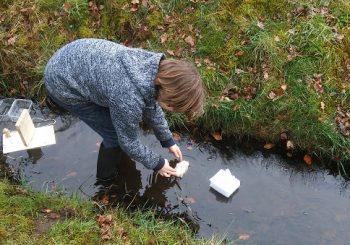
That education really works this way was demonstrated by two 12 year old boys when they had their first regular mathematic lessons. “We already know everything in this book, but never had mathematics before!” “Yes, but we learned decimal fractions while doing experiments at the stream in the wood, and do you remember that game of bridge building? That time we also learned a lot about mathematics!”

(This article has been published in Adbusters)

Options:email post email postleave a responsetrackback