What’s Next? Consciousness!
By Aventurijn on July 12, 2006Category: Education
Responses:
Last week an enormous tipi was built on the premisses of our democratic school Aventurijn in the Netherlands. All children and tutors could sit in the tipi around the fire and listen to stories, sing native Indian songs or make bread on the fire. Together we created an atmosphere of peaceful togetherness. It was a deep learning experience without calling it learning:
- learning from life;
- learning from examples (both of behaviour and knowledge);
- learning from the being of adults and other children;
- learning with heart, body and head.
Of course the children didn’t have to be in the tipi because their freedom to choose what they want to do, is an important condition at the school. A condition; not the ultimate goal. There are more conditions like providing safety, love, a rich environment etc. A condition means that there is more than just freedom and democracy. A lot more. For us, the only real goal of our school is the unfolding of the inner self in the human being: both with children and adults.
A BBC research resembled our own experiences, that in any communicative situation, 55% of what’s retained is the context. Body language, facial expressions and attitude constitute 38% of what will be remembered. With regards to the content of what has been said, this will only make up 7% of what is recalled later in time.
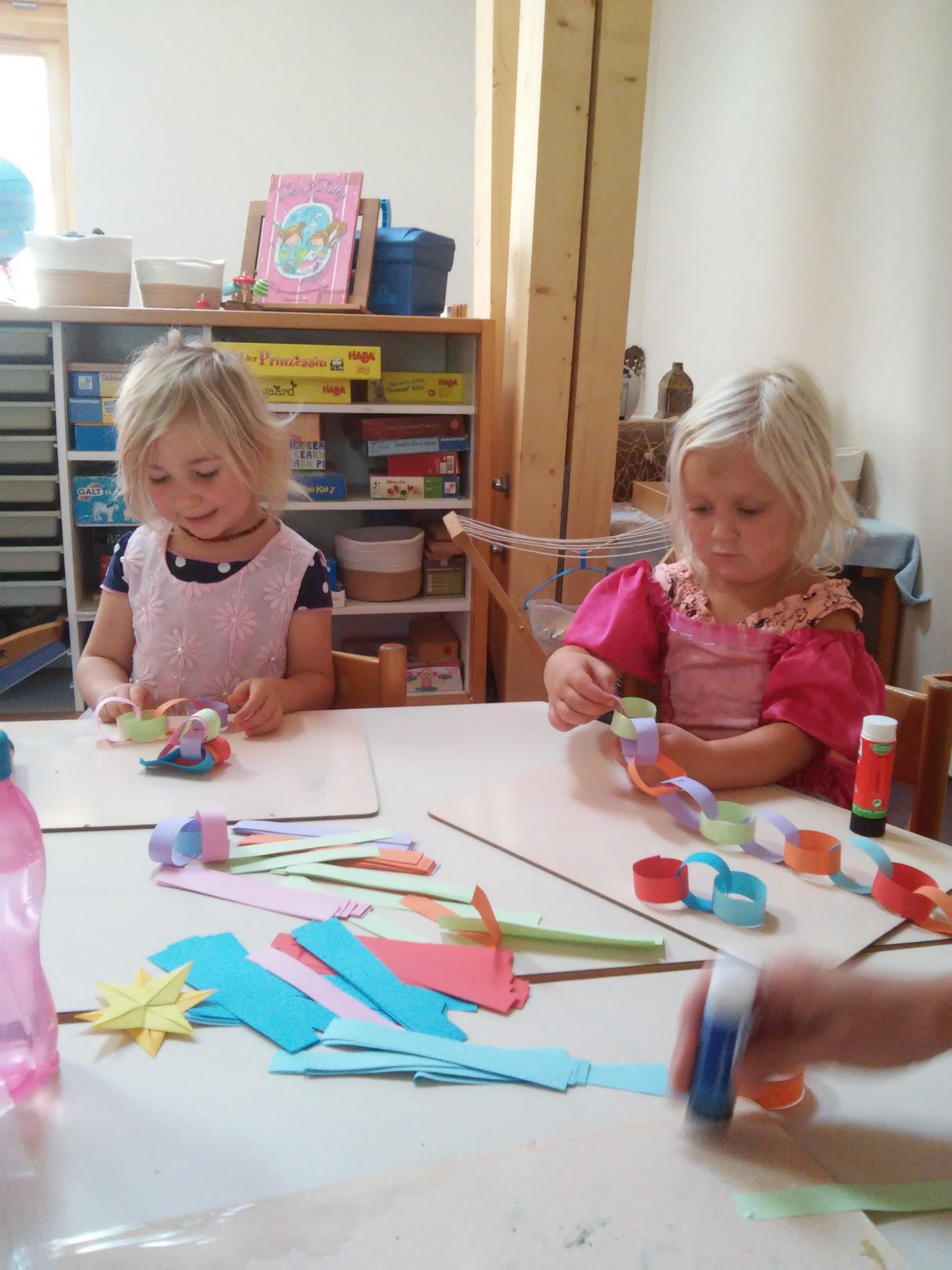
The knowledge gained by this research implies some major consequences for our current (formal) education. If you leave a child in an enclosed room with no other people or interesting things around to engage with, there would hardly be any development. It is important to create an environment which contains a lot of meaningful and interesting things and also inspiring people which surpass the notion of ‘just happening to be there’.
Last winter one of the tutors worked on a project about the Celtic culture. There where a lot of Celtic activities which the children could join in if they wanted. A lot of them didn’t, but the information was all around. To be heard, to be seen, to be felt, to be tasted, but more: ‘it was in the air’. A few weeks later one of the boys whom I thought had done nothing with this subject, was suddenly telling me a lot about it. While playing he had picked up on much of the Celtic information. On Aventurijn we call this ‘learning from thin air’.
It naturally follows that everything which happens at school has an influence on the children. When you are aware of this mechanism as a facilitator, you hence have the responsibility to keep a close eye on the whole atmosphere around each child. Because even if a child does not ask for this information, it will come in subliminnally. You therefore have to ask yourself continuously: what do I want to give these children.
Which leads me to the most important issue in my opinion: the awareness level of the adults.
You can give the children as much freedom and democracy as you want. But only when the adults are conscious about their own processes and work on their personal development, the children will have useful examples and references to grow up to. The behaviour and whole-being of the people around the child are of the highest importance when it comes to the child’s own development.
How does all of the above translate to the lessons the children ask for, like mathematics, physics, languages etc.?
We could offer a book or an ordinary lesson just like teachers do in thousands of schools around the world. Some children will even like it, but the question is: would this the most effective way of learning?
I don’t think so. There are a few thing that need to be mentioned in relationship to learning:
-
Every human being has his or her own preferred way of learning (with reference to the multiple intelligences theory by Howard Gardner). Some learn best when being outside, others want to move, some learn most by doing games or playing music, etc. etc.
-
Your learning is most effective when your heart and brain are working together in harmony.
-
A child needs to feel that it is totally accepted: mistakes don’t exist, neither do tests nor anything else which could imply that you are good or bad.
-
The teacher really has to believe that the child possesse an innate knowing about everything. All knowledge is already somewhere within, you only have to remember where.
-
When a teacher engages in real deep contact with the being of the child, a direct exchange of information can happen (with reference to the book: ‘Anastasia’ part 3, by V. Megre).
It’s my experience that social and emotional learning are as important as cognitive learning. Only when a child experiences total safety in its being, there is room for cognitive learning.
For this reason we pay a lot of attention to this. It also is the reason that the adults are the first ones to set examples by their way of being. The way in which we communicate with each other and the children is very important. Things that we pay attention to are:
- What is your body-language telling?
- What are you really saying behind your words?
- How do you manage your own emotions?
- Do you dare to share them with the children?
Then of course there is the developmental process of the child itself. We help a child to express and manage its emotions as required by the situation or when the child asks for it. But also in the group we offer activities, stories and games that give the children the opportunity to develop their social and emotional being.
Emotionally ’safe’ games for instance would be co-operative ones instead of competitive. We play them a lot. No winning, no losing. The effect of this is enormous! Children just play for fun, even when they themselves play a competitive game. I hardly ever see sad children because of losing, since we started doing co-operative games.
When a new child starts at our school and its behaviour is more violent than we are used to, I often hear children saying: “Oh well, he is not used to the way we interact yet; it will come.”
After being freed from compulsory education, the time has come take the next step. Adults have to unfold their own inner-self and doing so, consciously create the conditions for the children’s development.
We could write books about how we do that in our school, Aventurijn, and yet we are still in the middle of these developments. A lot of other people wrote books already about some aspects. Important books that might be interesting for you, to find out ‘what is next’ for you and your school.
I wish you a very inspiring conference!
Always open for questions and remarks,
Hannah de Vos-Beckers
Founder of Aventurijn
(This article was written for the international conference of democratic education 2006 in Sidney, Australia)
Options: •
email post
•
responses rss •
trackback
John Holt